Showing posts with label temple. Show all posts

Tuesday, July 7, 2015

Chiang Rai - Wat Rong Khun

Wat Rong Khun is actually not a temple. Rather, it is an unconventional and privately owned art-exhibition built in the style of a temple. It is owned by Chalermchai Kositpipat who designed the building details and who has funded most of the construction costs (by now well over USD 1 million).
The bridge of the cycle of rebirth leads to the gate of heaven. On the other side of the gate, you enter the ubosot
The "temple" opened to visitors in 1997, but has only become a major tourist attraction over the past 10 years. It is located around 5 kilometers south of Chiang Rai, so it is within easy reach for any visitor to the city.
Visitors are not allowed to take pictures inside the ubosot, but the entire back wall is taken up by a painting of a red demon with George Bush in one eye, and Osama Bin Laden in the other. Inside the mouth of the demon is a scene depicting the fall of the Twin Towers.
 
Pop culture references are found dotted throughout the demon’s mouth. They include the Kung Fu Panda, Michael Jackson, Neo from The Matrix, Freddie Krueger, Darth Vader, one of the Transformers, Hello Kitty, the Hulk, Batman, the Joker, Jigsaw from The Saw movies, Ultraman, Spiderman, Superman, a couple of Angry Birds, Harry Potter, and Jack Sparrow.

Confused? 
The pamphlet from the gift shop says the painting depicts “the killing of the innocence” by terrorism and fanaticism and that no heroes can save the world.

Monday, May 25, 2015

Chonburi - Wat Yannasangwararam

Wat Yannasangwararam Woramahaviharn is located in Huay Yai municipality, roughly 15 km south of Pattaya. Its location is more easy to pinpoint if you continue on Sukhumvit Road (Highway 3) to the Na Jomtien area where you then soon will find signs guiding you in the right direction.
Construction of the temple started in 1976 and the Royal Family have supported this temple since then. The Supreme Patriarch intended this temple be a place for practicing Dhamma and wanted a location relatively near Bangkok.


Inside the temple compound area, there are plenty of trees to provide shade and full facilities for visitors such as food, drinks and clean restrooms. There is also a museum explaining the basic Buddhist terms to laymen.  My favorite quote is: "You alone can change yourself". You cannot blame other people for your deeds - it is up to you to avoid committing sin by choosing the right path.

Saturday, January 31, 2015

Nakhon Phanom - Temples

Wat Okat at Night
There are several beautiful and important temples located in Nakhon Phanom city. At night, they are lit to show their best side and it makes a stroll along the Mekong River interesting. I have chosen Wat Okat as an example of the night time splendor.
The building to the right houses two images carved in wood. According to legend, these two imaged, called Phra Tiu and Phra Thiam, floated across the river roughly 1,000 years ago. These images are very sacred and seen here with very colorful murals on the walls.
I mentioned Wat Phra That Phanom in an earlier blog

http://tinamue.blogspot.com/2011/06/nakhon-phanom-once-upon-time-2.html

Chedi at Wat Phra That Phanon
It is located south of the provincial capital and is probably the most important Buddhist temple in eastern Isan. The 57 meter tall chedi is iconic and presumably contains a piece of the Lord Buddha's chest bone. A large festival to celebrate the temple starts the 10th day of the third lunar month and lasts for a week. This is normally in February, so in about two weeks' time, an estimated 10,000 people will make pilgrimage to the temple.

Friday, January 9, 2015

Chonburi - Sri Racha

Sri Racha is an old fishing village and center for seaborne transport that has grown big. Off the coast is Koh Si Chang. That island provides natural shelter for ships and has for centuries been a stopping point for vessels going to or coming from Bangkok. Even before that, the shelter provided by the island also allowed transshipments to take place - cargoes were moved from large oceangoing vessels to barges that went up to Ayutthaya. Sri Racha therefore became the home to customs house and immigration authorities to handle the interaction with foreign merchant vessels.
Chinese Buddha?
Wat Ko Loi is located on a small island connected with the mainland by a 1.5 km long causeway. The temple mixes Thai style Buddha statues with Chinese religious icons. It is the center for many festivals during the year, including Loy Krathong. On the island, there are also concrete ponds with large turtles and it may bring you good luck to feed them.
Ang Sila is located north of Sri Racha, just south of Chonburi city. It is another old fishing village that has become a popular tourist destination. It is not amazing beaches that attract people, but a reputation for amazing seafood.
Bay at Ang Sila


Tuesday, December 30, 2014

Chonburi - New Year at Wat Song Metta

When entering a new year, this is most often something people celebrate. However, many people take the opportunity to ponder the year that has passed and look ahead at what the new year may bring. Apart from the widespread tradition of making somewhat superficial resolutions for the new year, some people take a more serious approach. They choose to enter a new year while praying at a temple.
People are gathering
Wat Song Metta Wanaram is on a hill overlooking Ban Bang Saray (or Sa-Re) near Sattahip. New Year's Eve it will fill up with people chanting and praying for hours led by the monks of the temple.
Find yourself a place and a white cotton thread
If you are a believer, or maybe just want to try anything to secure some good fortune, then join us tomorrow evening. Or listen in on the internet radio broadcast.

http://www.watsongmetta.com/

Happy New Year

Thursday, December 11, 2014

Chonburi - Pattaya: City of Culture

Every year in December, Pattaya City sponsors a merit making ceremony early a Saturday morning. Last year, 2,600 monks were bused in. 
At his speech, and I am paraphrasing, the mayor of Pattaya said the ceremony was partly intended to show that Pattaya is not only a city of sin. However, I am pretty sure that this ceremony – starting at sunrise – escapes the attention of nearly all tourists and of the Thais engaged in the many shades of sinful activity that goes on all around Pattaya.
After the speeches, the monks circulated to allow worshipers to pay their respects and get their prayers answered. Considering that the Lord Buddha taught that the way to salvation is to free oneself from temptations and unholy matters such as money, it was an interesting aspect of the ceremony that 60% of the MC’s calls for prayer were for riches.

Friday, November 14, 2014

Surat Thani - Chaiya (2)

I already mentioned Wat Praborommathatchaiyaratchaworawiham in an earlier blog and this is definitely a destination worth going to again.

http://tinamue.blogspot.com/2011/10/surat-thani-chaiya.html

This time, however, I took the time to explore some hot springs in Chaiya. Only a few kilometers away from Wat Praborommathatchaiyaratchaworawiham -- down the small road that also passes the ruins of an ancient stupa --  is a small but steep hill with a couple of small caves. The hill is also the source of a hot spring. Since times as ancient as Wat Praborommathatchaiyaratchaworawiham, the hot spring was used to feed two pools. According to signs at the site, it was people of Indian origin who brought with the a tradition for hot baths as part of religious rites. The two caves also became "holy".
Hot but not enticing
Since these hot ponds turned out to be useless, I sought the advice from my GPS. It informed me that there were another hot spring relatively nearby. This hot spring -- about 4 km outside of town -- was much more difficult to find, partly because of a lack of signage, but primarily because my GPS indicated I should take a road that did not exist.
Hot mineral water
I eventually ventured along a gravel road that lead to a temple on the top of a hill. Just at the foot of the hill, a couple of ponds had been constructed from concrete. But, again, the area and the facilities appeared deserted and unused. The mineral water overflow from the concrete ponds discolored the rocks as it made its way down hill for form a small lake. The rocks looked to my untrained eye somewhat like lava, but was in Thai named Lan Lonk Prachan.


Friday, September 26, 2014

Roi Et - Wat Pha Namthip Thep Prasit Varanam

Remembering names is not easy. I was in western Yasothon when somebody spoke highly about Wat Pha Namthip. This was supposedly an amazing temple, which I should not give a miss. So, I followed the directions given and soon crossed into Roi Et province where signs started mentioning Phra Maha Chedi Chai Mongkol.  It turned out that there are two names for the same temple. Locals use the name of the temple whereas visitors tend to use the more grand name for the chedi. 

And it turned out that I have been there before.


This time, repair and refurbishment work on the chedi was in process, so it was not easy to take pictures of the impressive interior without scaffolding or tools getting in the way.
From the outside, the pagoda is still impressive as well as huge (101 x 101 meters at the base and 101 meters high). To reach the uppermost room, one has to climb a narrow staircase, before one can pay one's respects as well as donate money to the on-going refurbishment work.

Friday, September 19, 2014

Nakhon Pathom - Buddhamonthon

The district is called phutthamonthon, but inside the park, the signs spells it Buddhamonthon. The park covers an area of 2,500 rai and was opened in 1957 to commemorate that it was 2,500 years since the birth of the Lord Buddha. 

After a long pause construction on the park resumed slowly in 1976 and the main Buddha statue was cast in 1981. The statue is almost 16 meters high and in a circle around the statue are sites representing the four main stages in the life of Lord Buddha: his birth, his Enlightenment, his first sermon, and his death.

The park also houses a museum and several ponds. People can relax under the shade of trees and enjoy the tranquility away from the hustle and noise of modern life.

In late 2011, the park was flooded for weeks on end. Almost USD 20 million were spent on draining the area and cleaning up the park 

Friday, September 5, 2014

Buengkarn - Phu Tok

I told the story about Phu Tok in an earlier blog.

http://tinamue.blogspot.com/2010/01/nong-khai-phu-tok.html
Phu Tok seen from the temple parking lot
I have now visited Wat Chetiya Khiri Vihan again. The rock cropping out in a otherwise flat landscape is still impressive and the network of staircases leading to the top seems only slightly less wobbly.
Gentle reminders at parking lot
In this blog, I will dedicate much more space to photos. The photos combined with the original blog should provide a full picture of the "Phu Tok experience".

It looks safe, doesn't it?
Making your way up is not intended to be easy. Wooden stairways encircle the rock and at certain locations, steep staircases lead to the next level. Except for the final stretch to the top level - this can only be reached by climbing up a path carved into the side of the rock.
7th level is up there - beware of the snakes !
But once the top has been reached, peace and tranquility will surround you. The top "floor" (7th level) is the top of the rock and it is all-natural - no ornate Buddha images or elaborate places of worship.
The path to the top level
The intention is that people shall ponder their values in life and realize that once this life ends, you cannot bring any material things with you to the next life. Moreover, once on top of the rock, it would be silly not to pause and take in the view.
View from the top - temple area and pond in foreground

Friday, August 8, 2014

Uthai Thani - Phathang Temple

This small village temple has an impressive Buddha statue located less than one kilometer of the main road.


On the way to the temple, you will pass the "ancient weaving cloth center" (an OTOP initiative) where you can buy over-priced hand-woven products.

Saturday, July 19, 2014

Nong Khai - Si Chiang Mai

Sala Keo Kou is at the provincial capital

http://tinamue.blogspot.com/2013/02/nongkhai-sala-keo-kou.html
Water is not falling
I went 80+ km to the west of Sala Keo Kou to explore a couple of waterfalls - Tan Tip & Tan Thong or Than Thip & Than Thong depending on how you transliterate their Thai names into English. However, since my visit was during the dry season, there was almost no water, so that was a waste of time.
Mekong at Hin Mak Peng
However, Si Chiang Mai is nearby - roughly 65 km to the west of Nong Khai city. The town is located on the banks of Mekong, just opposite Vientiane, the capital of Lao PDR. Its name is derived from Chiang Mai as the Lan Xiang king that founded Si Chiang Mai had a grandmother who was queen of Chiang Mai.
Vientiane at night
That origin of the name is rather irrelevant today, but the location gives for some great nighttime views across the river of Vientiane's lights. So, it is very nice to have dinner at one of the many basic restaurants along the river.
Chedi with the remains of Luangphu Thet
A once famous temple is located bit west of Si Chiang Mai. Wat Hin Mak Peng became the permanent base of Ajarn Thet Thetrangsi from 1977. Before that, he had been a "homeless monk" wandering through the rural areas of Thailand. At that time, Wat Hin Mak Peng was at a very remote location, but Luangphu Thet gained a large following as a master of meditation and teacher in the "forest tradition" (khammatthana) of Theravada Buddhism. He gained such a reputation that he on several occasions were visited by members of the Thai royal family, including by HRH King Bhumibol. Luangphu Thet died in 1994, but the temple is worth a visit. The temple grounds are large and with plenty of trees to provide shade and the temple area is adjacent to the Mekong River.
Wat Hin Mak Peng seen from the river
The Mekong River is in itself an attraction. Nong Khai being so far away from the sea, the river banks serve as beaches and locals also engage in fishing.
In the photo, the guys in blue and orange shirts are holding the two ends of a net they've dragged out into and along the river. They are now about to bring the ends together onshore to collect their catch.

Thursday, June 12, 2014

Chonburi - Sanctuary of Truth

Located on Laem Rachvate in Na Kluea (just north of Pattaya) is a somewhat peculiar structure. While the webpage talks about ancient (Eastern) vision and wisdom as well as of ancient Thai ingenuity, the wooden building's style is an overly "busy" version of Khmer architecture.
While that in itself can be interesting -- and the official website (see link below) goes to a great length explaining the symbolic meaning of the many carvings -- I am not impressed by the entrance fees charges, by the tourists that arrive by the bus loads, and by the numerous side-activities going on to generate revenues.

http://www.sanctuaryoftruth.com/history.php

To me, money rather than spiritual enlightening and pursuit of "truth" has become the main objective. But, each to one's own.

Sunday, March 16, 2014

Chantaburi - Khao Khitchakut 2

Access to the Khao Khitchakut is possible for two months each year, normally between Chinese New Year and Magha Puja day (roughly late January to March).

I reported on Khao Khitchakut two years ago.

http://tinamue.blogspot.com/2011/12/chantaburi-khao-khitchakut.html

Drop point at top of dirt road. The trek begins from here.
The pilgrimage to Khao Khitchakut gets ever larger. While it was bad two years ago, it is now a total "circus". Fortunately, getting the two rides on pick-up truck to the top went quite smoothly. Many passengers seemed awestruck that it is possible to drive relatively fast on a dirt road - not something they are used to when shuttling around Bangkok in their air conditioned sedans - so they were recording the rides on their mobile devices. The road to the top is a dirt road, but it is relatively wide and relatively smooth. Although steep at places, it was a much better road than some of the tracks I've been on in Ratchaburi and Kanchanaburi.  And it is simple physics that it makes it easier to drive up if speed (and thus forward momentum) is kept above 20 km/h.
You shall not walk alone
After driving 3-4 km from bottom to top, it is time to get off the pick-up and dive into the sea of people. The path leading up is mostly narrow and always cram-packed. Patience is required. After less than a kilometer, the track really narrows and gets steep. Obviously, this creates a bottleneck. After waiting for twenty minutes without moving more than a few inches, an experienced pilgrim (this being her fourth visit) remembered a short-cut. I and a few others followed her. We back-tracked 100 meters, veered off the paved but crowded track, sneaked in between some ramshackle shops, passed some temporary toilets, and there it was: a path in the forest leading up. It was a steep climb, but there wasn't any crowd.

Once up at around 1,000 meters above sea level, and back into the crowd, one has to walk from peak to peak to pray and to admire the various geological phenomena that to pilgrims appear to be related to Buddhist myths. For example, there is a stone pagoda, a rock that looks as an upside down monk’s alms-bowl, the hermit cave, and huge rocks that look like a turtle and an elephant.
Patience - it took around 40 minutes of standing in line before the rock was reached
The most famous / important destination is Lord Buddha’s footprint (at the foot of the rock pictured above). There the ushers (broadcasting via large loudspeakers) remind people that a 200 baht donation could (potentially) result in lottery winnings of 200 million baht. Not a bad rate of return. One also suggested other wishes one could make such as getting "Pancake" as one's girlfriend.

For a clue to who Pancake is, check out:

http://tinamue.blogspot.com/2011/08/thai-nicknames.html

At other holy locations, the guys with microphones promised less - the promises ranged from 3 - 5 million baht - and nobody saw any irony in that Buddhists come to pray for material success in life when Lord Buddha teachings center on that craving leads to suffering.
Write your wish on a red cloth, tie the ribbon, and pray.
Another interesting praying location had several options for people, including statuettes of Lord Buddha and of King Taksin the Great. Again without the slightest whiff of irony, there were also several statues of Hindu gods that people could pray to.
Buddhists can pray to Hindu gods
If you like crowds and/or if you believe Buddha will make your wishes come true, a visit to Khao Khitchakut is a must.


Wednesday, February 19, 2014

Phrae - Temples

Phrae has beautiful nature, but the province is also home to many interesting temples.
Chedi of Phra That Cho Hae
One of the most famous temples in Phrae is Wat Phra Thot Cho Hae, which originally was built in the 14th century. The chedi is 33 meters high and 10 x 10 or 11 x 11 meters at the base - size depends on which sign you read. The chedi was built in Chiang Saen and contains (pieces of) the Lord Buddha's hair and elbow bone.

The "Cho Hae" part of the temple's name comes from the "cho hae" cloth from ancient Mengbanaxi (today Xishuangbanna in Yunnan) that was used to wrap around the chedi as part of religious rites.
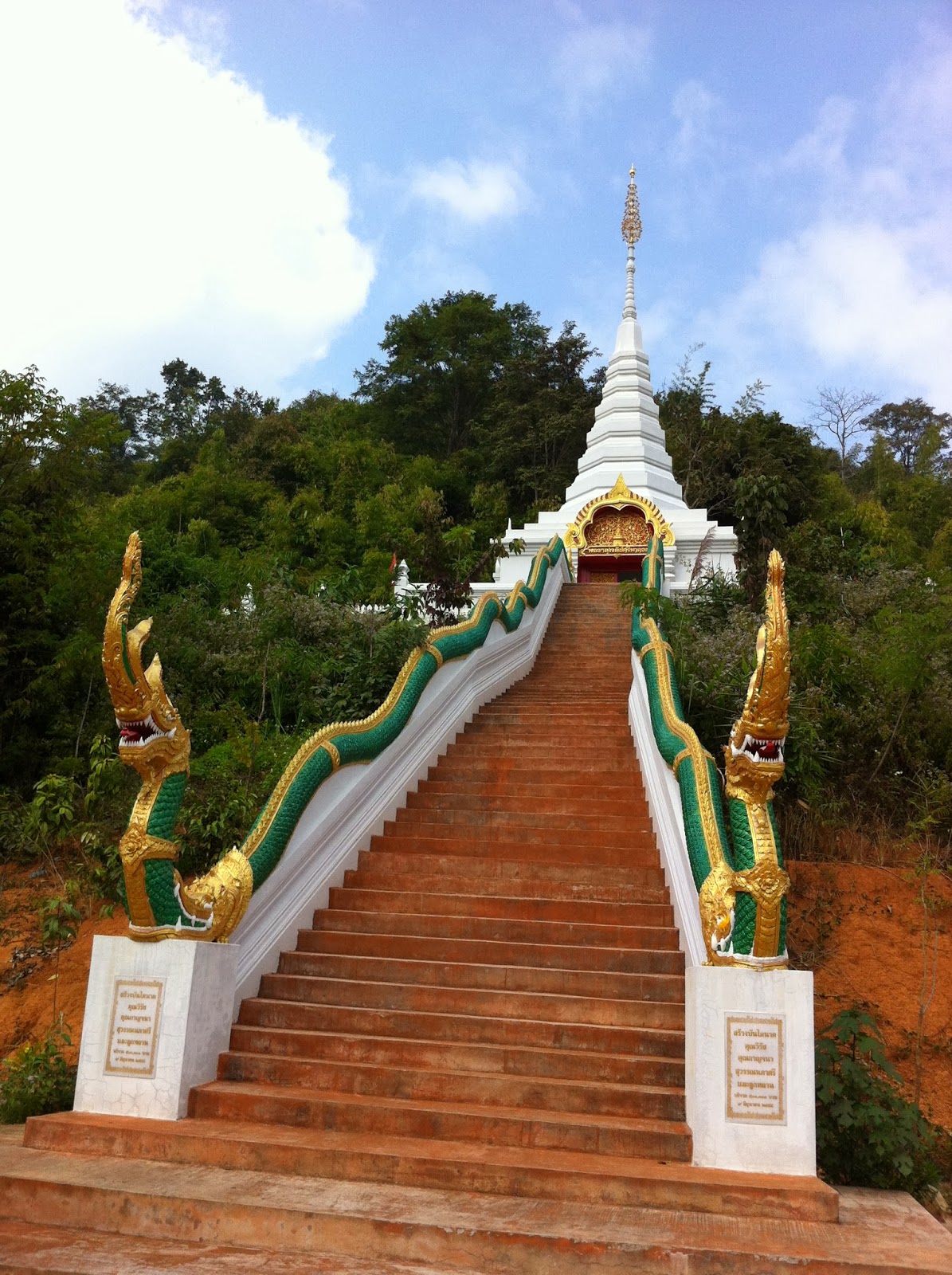
Don't mind the tigers, use the Mythical Lion Staircase
The temple is located on the top of a hill. One can ascend the hill by using the Mythical Lion Staircase, although the artists seem to be confused about which carnivore looks like what.
The Buddha statue near the chedi offers a very attractive photo opportunity and is a fine work of art.
At the foot of the hill, a statue of a reclining Buddha is unceremoniously hidden away in a rather inconspicuous structure. It deserves better.
Wat Chom Sawan
Wat Chom Sawan (located near the current city center) is a much newer temple. It is interesting because it is built in teak wood and built in hill-tribe (Thai Yai) style. It was built during 1900-1912. The interior is nicely engraved teak with colored glass to enhance the effect.
The Buddha image is heavily influenced by Burmese style, so Wat Chom Sawan is a wonderful mix of cultures and architectural styles.
The last temple from Phrae that I mention will - unfortunately - remain nameless. I forgot to note the name down. This temple was located about a dozen kilometers down a road the dead-ended in a valley north-east of the provincial capital. While the main temple structures were a the valley floor, near a picturesque stream, the chedi was located up at the end of several long stair cases. These stair cases were, however, devoid of any mythical lions.