Sunday, March 16, 2014

Chantaburi - Khao Khitchakut 2

Access to the Khao Khitchakut is possible for two months each year, normally between Chinese New Year and Magha Puja day (roughly late January to March).

I reported on Khao Khitchakut two years ago.

http://tinamue.blogspot.com/2011/12/chantaburi-khao-khitchakut.html

Drop point at top of dirt road. The trek begins from here.
The pilgrimage to Khao Khitchakut gets ever larger. While it was bad two years ago, it is now a total "circus". Fortunately, getting the two rides on pick-up truck to the top went quite smoothly. Many passengers seemed awestruck that it is possible to drive relatively fast on a dirt road - not something they are used to when shuttling around Bangkok in their air conditioned sedans - so they were recording the rides on their mobile devices. The road to the top is a dirt road, but it is relatively wide and relatively smooth. Although steep at places, it was a much better road than some of the tracks I've been on in Ratchaburi and Kanchanaburi.  And it is simple physics that it makes it easier to drive up if speed (and thus forward momentum) is kept above 20 km/h.
You shall not walk alone
After driving 3-4 km from bottom to top, it is time to get off the pick-up and dive into the sea of people. The path leading up is mostly narrow and always cram-packed. Patience is required. After less than a kilometer, the track really narrows and gets steep. Obviously, this creates a bottleneck. After waiting for twenty minutes without moving more than a few inches, an experienced pilgrim (this being her fourth visit) remembered a short-cut. I and a few others followed her. We back-tracked 100 meters, veered off the paved but crowded track, sneaked in between some ramshackle shops, passed some temporary toilets, and there it was: a path in the forest leading up. It was a steep climb, but there wasn't any crowd.

Once up at around 1,000 meters above sea level, and back into the crowd, one has to walk from peak to peak to pray and to admire the various geological phenomena that to pilgrims appear to be related to Buddhist myths. For example, there is a stone pagoda, a rock that looks as an upside down monk’s alms-bowl, the hermit cave, and huge rocks that look like a turtle and an elephant.
Patience - it took around 40 minutes of standing in line before the rock was reached
The most famous / important destination is Lord Buddha’s footprint (at the foot of the rock pictured above). There the ushers (broadcasting via large loudspeakers) remind people that a 200 baht donation could (potentially) result in lottery winnings of 200 million baht. Not a bad rate of return. One also suggested other wishes one could make such as getting "Pancake" as one's girlfriend.

For a clue to who Pancake is, check out:

http://tinamue.blogspot.com/2011/08/thai-nicknames.html

At other holy locations, the guys with microphones promised less - the promises ranged from 3 - 5 million baht - and nobody saw any irony in that Buddhists come to pray for material success in life when Lord Buddha teachings center on that craving leads to suffering.
Write your wish on a red cloth, tie the ribbon, and pray.
Another interesting praying location had several options for people, including statuettes of Lord Buddha and of King Taksin the Great. Again without the slightest whiff of irony, there were also several statues of Hindu gods that people could pray to.
Buddhists can pray to Hindu gods
If you like crowds and/or if you believe Buddha will make your wishes come true, a visit to Khao Khitchakut is a must.


Monday, March 3, 2014

Bangkok - Chocolateville

This “take a picture destination” in a Bangkok suburb looked great on the photos I saw on internet. I imagined it would be a rather large location with several restaurants and souvenir shops (similar to Asiatique and Mimosa).


However, it turned out to be rather small – basically just an outdoor restaurant surrounded by a number of “cute” houses and decorative items offering photo opportunities.

I was a bit disappointed, but I guess it is an OK destination if one wants to try a new restaurant so here is the link:

http://www.chocolateville.net/

Friday, February 28, 2014

Thailand - Funny Signs

On road trips, one often encounter funny signs or signs one wonder why they were deemed necessary.
For example, in Ratchaburi, it is OK to bring your gun to a waterfall, but please don't shoot.

In Phattalung, deer are apparently not allowed to enter this forest.
 In Phang Nga, the local government provide a public swamp instead of a park for citizens and visitors.

In some instances, like below example from Cambodia, there is an issue with translation. The electricity factory referred to is actually a power plant.
Other examples from Cambodia are found in the creativity put into name giving of retail businesses and language schools. For example, 6-Eleven and K-Mart Burger are names of local mini-marts.

That reminded me of a burger chain in Kazakhstan that named itself King Burger and used colors & designs in its logo so that the similarity with Burger King was obvious. The burgers' taste was, however, pretty fatty and deplorable.

Wednesday, February 19, 2014

Phrae - Temples

Phrae has beautiful nature, but the province is also home to many interesting temples.
Chedi of Phra That Cho Hae
One of the most famous temples in Phrae is Wat Phra Thot Cho Hae, which originally was built in the 14th century. The chedi is 33 meters high and 10 x 10 or 11 x 11 meters at the base - size depends on which sign you read. The chedi was built in Chiang Saen and contains (pieces of) the Lord Buddha's hair and elbow bone.

The "Cho Hae" part of the temple's name comes from the "cho hae" cloth from ancient Mengbanaxi (today Xishuangbanna in Yunnan) that was used to wrap around the chedi as part of religious rites.
Don't mind the tigers, use the Mythical Lion Staircase
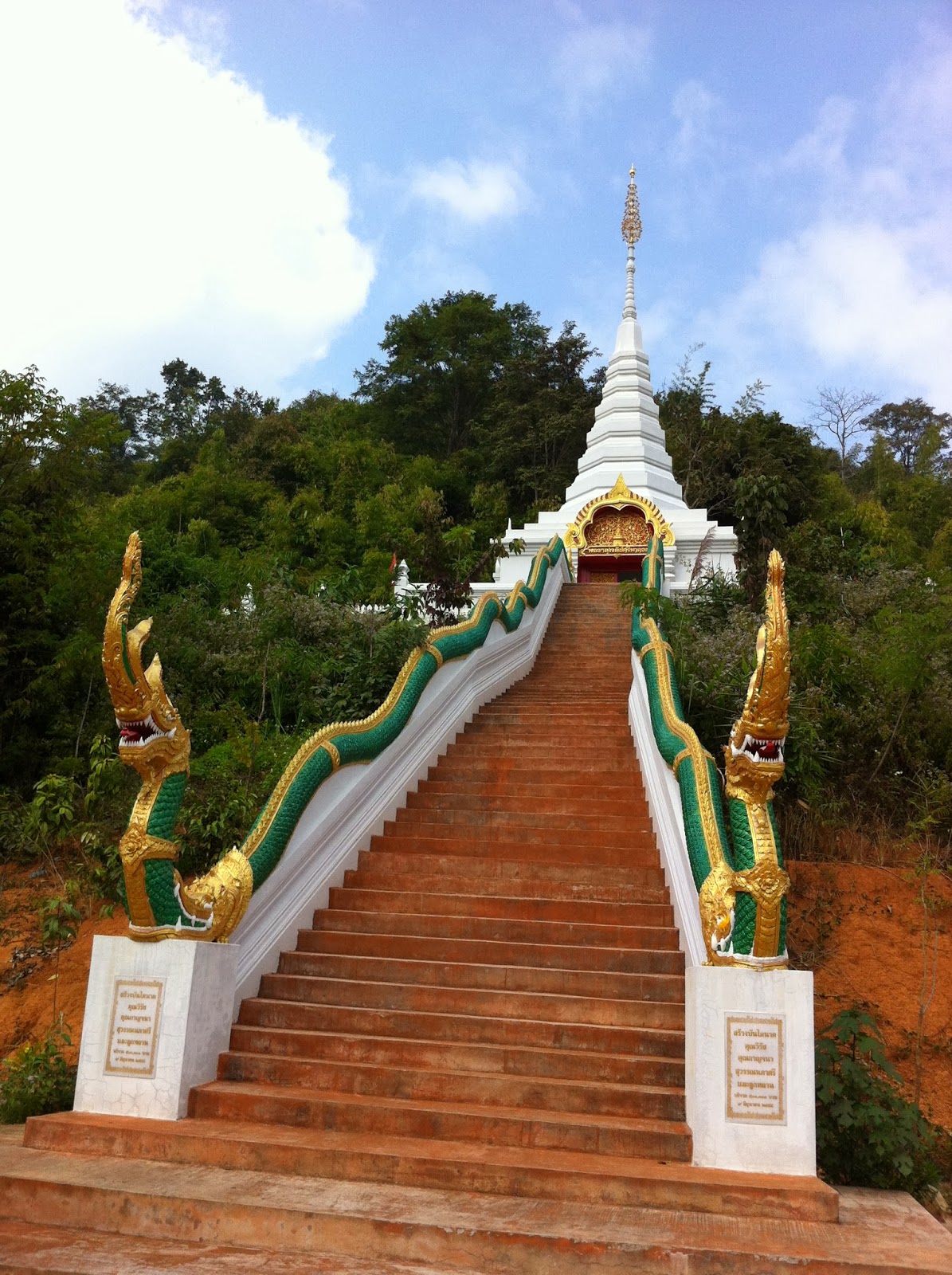
The temple is located on the top of a hill. One can ascend the hill by using the Mythical Lion Staircase, although the artists seem to be confused about which carnivore looks like what.
The Buddha statue near the chedi offers a very attractive photo opportunity and is a fine work of art.
At the foot of the hill, a statue of a reclining Buddha is unceremoniously hidden away in a rather inconspicuous structure. It deserves better.
Wat Chom Sawan
Wat Chom Sawan (located near the current city center) is a much newer temple. It is interesting because it is built in teak wood and built in hill-tribe (Thai Yai) style. It was built during 1900-1912. The interior is nicely engraved teak with colored glass to enhance the effect.
The Buddha image is heavily influenced by Burmese style, so Wat Chom Sawan is a wonderful mix of cultures and architectural styles.
The last temple from Phrae that I mention will - unfortunately - remain nameless. I forgot to note the name down. This temple was located about a dozen kilometers down a road the dead-ended in a valley north-east of the provincial capital. While the main temple structures were a the valley floor, near a picturesque stream, the chedi was located up at the end of several long stair cases. These stair cases were, however, devoid of any mythical lions.

Wednesday, February 5, 2014

Phrae - Mountains

Apart from Phae Muang Phi and temples, Phrae is of course famous in Thailand for its mountainous topography and cold winter nights. During the cold season, especially over the New Year holidays, many Thais from the central and coastal regions travel north to experience cold weather as temperatures can drop to around 10 degrees Centigrade. To them, it is a bliss to freeze a bit next to a mountain stream, so for resorts and hotels up north, the cold season is the high season.
Home Stay Mountain Style
I am not sure whether 1,000 meter peaks meet the international standard for mountains (or whether any such standard exists), but towards the borders with Uttaradit and Nan, Phrae has lush mountains with great views and plenty of waterfalls to explore.
Choeng Thong Waterfall
I have seen too many waterfalls to be excited about seeing one more or one less. I have a tendency to seek out the less-traveled roads although they often are not short cuts. In the mountains, there were several of these roads that went winding on forever without taking me anywhere.
Why should we get outta the way?


Friday, January 31, 2014

Phrae - Palace of Prince

Phrae has many beautiful buildings. I was most impressed by the architecture and the "feel" of the residence of the last ruler (prince or royally appointed governor) of Phrae. The building is called Khum Chao Luang and was built in 1892 mixing Thai and European architectural styles.
Khum Chao Luang (or Palace of Prince) with a statue of Chao Luang Piriyatheppawong

The building has been turned into a museum, which most definitely is worth visiting. The prince (and his two consorts) lived on the top floor, while the middle floor was partially "office space" (i.e., used for official functions) and partly private living space.

Servants, slaves, and prisoners occupied the basement where also tough punishment was metered out.
You better stay on your toes.
Prince Piriyatheppawong contributed to the "modernization" of Phrae and his accomplishments were greatly appreciated by King Rama V. However, a set-back occurred in 1902 when the Shan tribes in the north of Thailand rebelled against Siamese rule.

Wednesday, January 22, 2014

Phrae - Phae Muang Phi

Just like at Pong Yup (Ratchaburi) and Lalu (Sa Kaeo), erosion has formed a special landscape in Phrae. As Phae Muang Phi is located only 17-18 km from Phrae city center, it is one of the most visited landmarks in Phrae.
Thailand's Grand Canyon
According to a signboard at the site, Phae Muang Phi is a mix of local dialect and Thai and roughly means "Forest Ghost Town". Legend has it that this name relates to an event centuries ago.
An old lady was foraging in the woods far from her village when she stumbled over a treasure. Excited, she took all the gold and silver she could carry and headed home.
However, the forest spirits guarding the treasure would not let the old woman return. She felt her load get heavier and heavier and that she seemed to go backwards rather than forwards. She finally gave up and dumped what she had taken. The spirits then let her return to her village.
When she reached her home, she immediately alerted the village people about the treasure. They all rushed back into the forest. However, where the treasury had been, they only found footprints. Determined, the villagers followed these footprints until they came upon a coffin. Convinced that ghosts and potentially evil spirits had a hand in this, they all scurried back to the village. To remind people to stay away from that area of the forest, they named it Phae Muang Phi.
Although an interesting legend, it fails to explain anything about the strange landscape erosion has left behind.

In any case, the area is not large. Although larger than Pong Yup, it to me seemed smaller than Lalu, but the erosion has cut deeper than at Lalu. It certainly takes longer to drive from Phrae to Phae Muang Phi than it takes to walk around the site.

Probably to compensate for that, the forest park administration has planted two (supposedly) ticklish trees. I could not get it to work, but according to signs, the leaves of these trees will fold if you gently touch the bark on the tree trunk.
Please be gentle when you tickle me