Showing posts with label cave. Show all posts

Monday, August 25, 2014

Kanchanaburi - Srinakarin Reservoir

Even on rainy weekends, Kanchanburi is worth a visit. It has been years since my last visit to the 7-tiered Erawan waterfalls and they are now a very busy tourist destination. Locals and foreigners play around in the cool water or lounge on the shores of the stream.  The falls are beautiful, but the atmosphere is not quiet and serene. The sheer number of people makes it difficult to get a feeling of "being one with nature." 
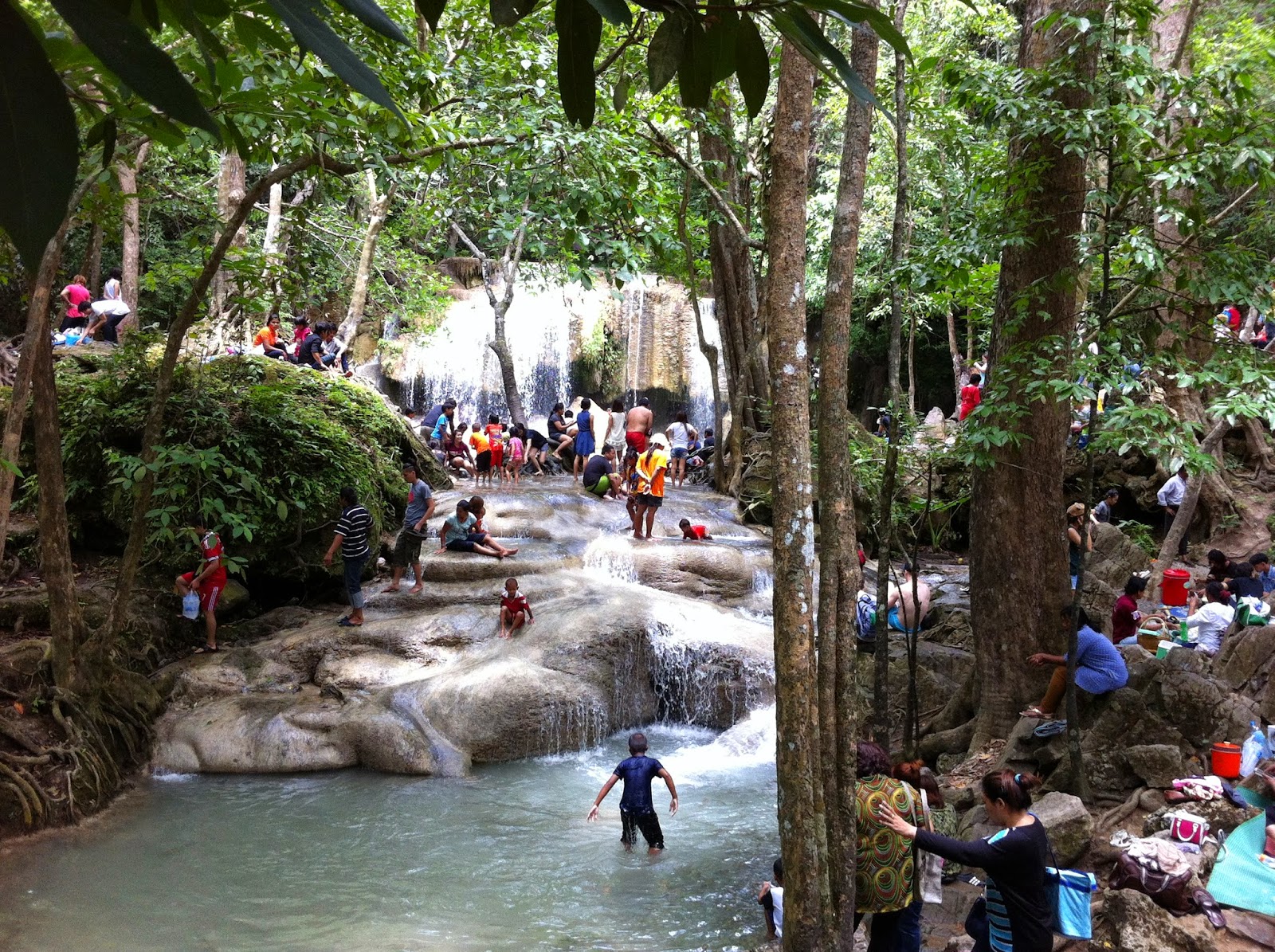
Erawan Falls and plenty of visitors
 So, I decided to head to Huay Mae Khamin Wateralls. Again.


On the way, I stopped at Pra That Cave. It was is quite a climb to get to the cave entrance. The path was well laid out, but the jungle humidity during rainy season made the climb a sweaty one. 

At the cave entrance, a park ranger waited and gave a guided tour once at least four visitors had arrived. Inside the cave were the usual stalactites and stalagmites, but I was surprised by the size of the cave. It is made up of four big rooms and is much bigger than I had expected. 

Next on the agenda was the Huay Mae Khamin Waterfalls - the upper tiers could only be reached if you were willing to risk being totally covered in mud as the paths along the stream had turned extremely slippery due to rain. So, I decided to only enjoy the lower tiers and the view of the Sri Nakharin reservoir. 
Beautiful Huay Mae Khamin 
In fact, I decided to catch a ferry to Si Sawat across the reservoir. Getting from the waterfall to the ferry is bumpy and a bit risky for sedans during the rainy season. The ferries plying this route can best be described as minimalistic, but they do serve their purpose and the trip offers good views. 
Two Rainbows Don't Make a Crowd
As we were crossing, dark clouds came towards us and soon we were drenched. But then, the rain stopped as abrupt as it had started and two rainbows appeared.

Once on the other side, one can drive along the edge of the reservoir - a winding and scenic route - or take another ferry which cuts an hour off the travel time to reach Kanchanaburi city.


Friday, February 15, 2013

Nong Bua Lamphu - Erawan Cave


The Erawan cave is located in a limestone cliff near the border to Loei. The cave entrance is reached by climbing a long winding trail of stairs, which – without a hint of irony – is named “Stairway to Heaven”. 
The stairs start at a Erawan statue and - after roughly 600 steps - end at the cave entrance where a large Buddha statue sits staring over the rice fields below.
The cave is very large, well lit, and – unlike other caves – spacious as the inside is “open” and nearly devoid of stalactites  This means that there isn’t much spelunking to do; no challenging tight spots, no risk ascends or descends, no need to carry a torch. In a way, it can be described as a family friendly cave.

Monday, December 24, 2012

Kanchanaburi - the Liijia Cave and the Fabled Japanese Treasure

On a total sidetrack, I came to think of the saga of the infamous Japanese Second World War treasure supposedly left behind in a cave in Kanchanaburi. Why anybody ever paid any attention to that story, I couldn't understand. Why the myth wasn't buried the first time around, is totally incredible.

In late 1995, Senator Chaovarin Latthasakiri (from Ratchaburi) was behind a drive to get the Thai government to fund a search for the treasure. The search went on for two months before it was abandoned. Not a single ounce was found out of the purportedly up to 6.000 tons of gold hidden by the Imperial Japanese Army.

In 1996, the Senator tried to increase the price of his Jaguar when he put it up for auction pretending to be selling a vehicle owned by His Majesty the King.

Not being a person that gives up easily, Chaovarin Latthasakiri (by then a former deputy Minister of Education) again in early 1999 tried to drum up interest in a government-sponsored treasure hunt, but his drumming fell for deaf ears.

However, in April 2001, Chaovarin Latthasakiri presented to the Thai press (copies of) old US government bonds as well as rumors of 2,500 tons of gold (plus a steam locomotive) hidden in the Liijia Cave. This created such a stir that then Prime Minister Thaksin Shinawatra flew to the cave's entrance to announce the government's backing of another treasure hunt.

Nobody wondered from where the Imperial Japanese Army would have gotten US government bonds and nobody questioned the denominations of the bonds. Each bond was valued between USD 50m and 100m - an incredibly large amount in the mid-1940s - i.e., in denominations that have never been used by the US Treasury.

Questions only arose after weeks of the Royal Thai Army searching turned up only dust.

Chaovarin Latthasakiri continued his political career as a avid supporter of Thaksin and is now a Member of Parliament for Phuea Thai Party.

Sunday, November 11, 2012

Surat Thani - Khao Sok

Khao Sok National Park covers an area of 738 sq. km and has spectacular limestone rocks and ridges studded with several large caves. There is pristine rain forest with wildlife sanctuaries and a large network for trekking. Many streams and rivers originate from this watershed and rafting, canoeing, as well as tube tours are arranged daily. These days there are even elephant rides. 
It should be obvious, but the reason it is called a rain forest is that it often rains. So, three out of my four visits to Khao Sok have been wet, but it is just a question of not being discouraged by the weather. 

My first visit ten years ago was the wettest -- and sleeping in a "house" built in a treetop on the bank of a stream did not make things less humid -- but included a great visit to a cave reached by boat (and a trek) from the Rachaprapah Dam. It was a U-shaped cave where the bottom end of the U was very narrow and one had to wade in cold chest-high water. 
Apparently, the treetop house concept caught on, so today there are plenty of fake treetop houses built in concrete. Khao Sok has developed into a popular stop-over for back-packers (if there are any those left) going from Khao Lak to Koh Samui and a weekend destination for nature lovers visiting Phuket or Khao Lak.

For Thais, Khao Sok is mostly famous for Rafflesia, which are the largest flowers in the world, and can grow up to 90cm in diameter. The flower is like a giant red bowl lined with yellow spotted petals. The flowers exude a strong smell – similar to the smell you would expect to find near a rotten carcass or a dustbin - but does fortunately not flower for long.