Showing posts with label island. Show all posts

Tuesday, March 3, 2015

Phang Nga – Koh Phra Thong


Koh Phra Thong Beach - White and Wide
This is a wonderful island with wonderful beaches and highly varied fauna and flora, which make the island a great destination to explore.However, visitors must be ready to accept that this island (supposedly) is the last tambon in Thailand to not have a public electricity grid, which means inhabitants only have electricity for three-four hours each evening. Although there is a ferry from the pier at Muh Koh Surin National Park’s office, there is no fixed schedule for departures. Transport to / from the island is mostly by means of long tail boats with Ban Ded being the main connection point on the mainland. After departure from Ban Ded, one passes through mangrove before crossing a short stretch of open water to reach the island.
All but one of the island’s five resorts have only basic structures (huts or tents) for rent. The Oasis Resort offers the best value for money with extremely friendly owners and large tents right on edge of a magnificent beach.
Around 600 people live on Koh Phra Thong. The island doesn’t have any paved roads, but does have some narrow concrete tracks, barely wide enough for one vehicle, that connect most of the populated locations to each other. Other locations are reached by tracks short-cutting through the wilderness. 

The eastern shores of the island are mostly mangrove forests. If you can get a local to take you around in a small boat to see birds and monkeys.The western shores of the island have kilometer after kilometer of truly unspoiled sandy beaches. There are no beach chairs or sun parasols, but plenty of crabs.
Map of Koh Phra Thong indicating savanna area in red

The interior of the island is dominated by a large sandy savanna – tall grass, shrubs, small trees (mostly pine and cajuput) – with small lakes and ponds full of mussels. The savanna is home to around 70 deer, 40 hornbills, and an unknown number of feral pigs. I borrowed a 20-year old book with information on the island. It listed eight different frogs, but 16 different snakes, so it is advisable to take due care when walking around on the savannah or in the forest on the island.To get around on the savanna is relatively easy in the dry season, but during the rainy season, the tracks turn muddy and often disappear as ponds become lakes.


The island has three villages and the southernmost village, Ban Tungthae, is basically cut off from the rest of the island during the rainy season. It had more than 300 inhabitants 10 years ago. But the tsunami dealt a hard blow to the village from which it hasn’t recovered. At present, Ban Tungthae is home to only around 60 villagers and the school is deserted.

Local Transport
The intermittent supply of electricity, poor infrastructure, and basic accommodation brought back memories of Koh Chang 20 years ago. However, even back then, Koh Chang had far more (backpacker) tourists than Koh Phra Thong has today. Back then, Koh Chang was also a popular destination among adventurous university students from Bangkok whenever there was a long weekend. Koh Phra Thong is far more quiet although it does on occasion get some visitors dropping by on their way to / from Muh Koh Surin or if boat services to Muh Koh Surin are suspended due to rough seas.
Big Bird defending its nest against nosy tourists

In any case, although Muh Koh Surin is amazingly beautiful, it is also small and it is easy to get bored. Koh Phra Thong is far larger and offers a multitude of activities, so it is far easier to spend long time on that island. I highly recommend a visit. 

Saturday, November 22, 2014

Surat Thani - Koh Phangan

I had vowed not to return to Koh Phangan as the island surely would be different than when I first visited. That was back in the days before Full Moon Party was invented, when no road connect Had Rin to the rest of the island, when there was no electricity and no swimming pools. But I had a business appointment on the island, so I decided to combine it with some R&R.
Had Rin Nai
Had Rin Nai is still a very nice beach, but Had Rin Nok is not that great. And the area behind it is now packed with structures put up with no prior planning making roads and alleys a maze. Many structures are shoddy constructions intended to house party revelers in bunk beds. Delicious food is not to be had as bars and sellers of buckets (with alcohol of questionable origins) outnumber restaurants on Had Rin Nok. The service staff are mostly from Myanmar and have little training, which can result in interesting combinations being served. For example, I was given chopsticks as utensils for a plate of Italian pasta.

That being said, Koh Phangan has many beaches apart from Had Rin. A drive along the coast from Thong Sala to Ban Chalok Lam will take you past several nice bays, which I would prefer over Had Rin, but none of them can be said to be deserted. I went to see Ban Chalok Lam because when I first visited, that bay was used as a graveyard for fishing vessels. When fishing vessels were retired from service, they were pulled up on the beach and cannibalized for parts.
Thong Nai Pan Beach
Ban Thong Nai Pan used to be hard to reach, but the road has now been upgraded - when I first visited, it could only be reached on horseback.
They worked when we bought them - why check if they still work?
On the ferry back to the mainland, I noticed that safety concerns are not high on the list of the ferry company's priorities.

Friday, June 20, 2014

Chonburi - Sattahip

Samaesan is a small "typical" Thai fishing village just south of the port / base used by the Royal Thai Navy. The smell is the first thing you notice in Samaesan. The pungent smell comes from the cooking, drying and processing of small fish (whatever they are called). During a boat trip you will see thousands of "silver fish" making big jumps out of the water around the boat. Thai people like to eat this fish dried or fried in oil with sugar and salt.

http://samaesan.com/Location/shop-19.html

To escape the smell, visit the beautiful temple on the hill. From there, there is the view of islands just off the coast with their white beaches and crystal-clear water.
The waters around the islands have several coral reefs and the wreck of Hardeep, which was sunk in the Second World War. It is now at the bottom of the sea at 26 meter and is a popular destination for SCUBA divers. The wreck is home to moray eels, sea turtles, and a lot of other marine life.
Wreckdiving is exciting and challenging. But the sea around Samaesan has strong and treacherous currents, which can be dangerous - I ran out of air during one of my Hardeep dives - so one has to be extra careful.

http://www.thaiwreckdiver.com/hardeep_wreck.htm

Wednesday, April 23, 2014

Surat Thani - Koh Samui Reminiscing

Koh Samui is today a modern resort island with direct international flights making it easy for tourists to get to the island.

It is not particularly Thai anymore as it competes to find its spot in the market place where other "beach & party islands" like Phuket and Bali vie to attract the same crowd. While Samui tries to move upscale, it still also attracts tourist hordes from Russia and the modern version of backpackers on their way to / from the monthly Full Moon Party on Koh Phangan.

When I first visited Koh Samui, there were no scheduled flights - the airport was tiny (could only be used by single-engine prop planes) and rarely used, there were no Full Moon Parties, and locals seemed mostly engaged in growing coconuts. Many people lived in wooden houses on stilts with their livestock - water buffalo included - roaming around freely.

The beach roads in Chaweng and Rawai were rough gravels roads. Bo Put was a sleepy fishing village where the local shop (too small to be a supermarket) doubled up as restaurant, post office, and exchange booth. There were no resorts with infinity pools and beach chairs, but the beaches were absolutely stunning and totally deserted.
I also remember that my visit to the waterfall was an adventure. Only the main road circling around the island was paved (concrete). All other roads were gravel roads. The road to the waterfall quickly became a track only to be used by motorcycles. A few kilometers from the waterfall, the track became impassible except on foot as it wound its way through the pristine jungle. After a semi-arduous journey, it was with great pleasure one stripped off one's wet T-shirt and jumped into the cold water at the foot of the waterfall.
Today, Samui's beaches aren't deserted and access to sights such as waterfall are neither arduous nor for free.

Friday, April 11, 2014

Trad - Koh Chang Sunsets

As we are getting ready for a busy week - the annual road carnage and excessive water splashing -to celebrate Thai new year, let's pause to appreciate the nature that surrounds us.
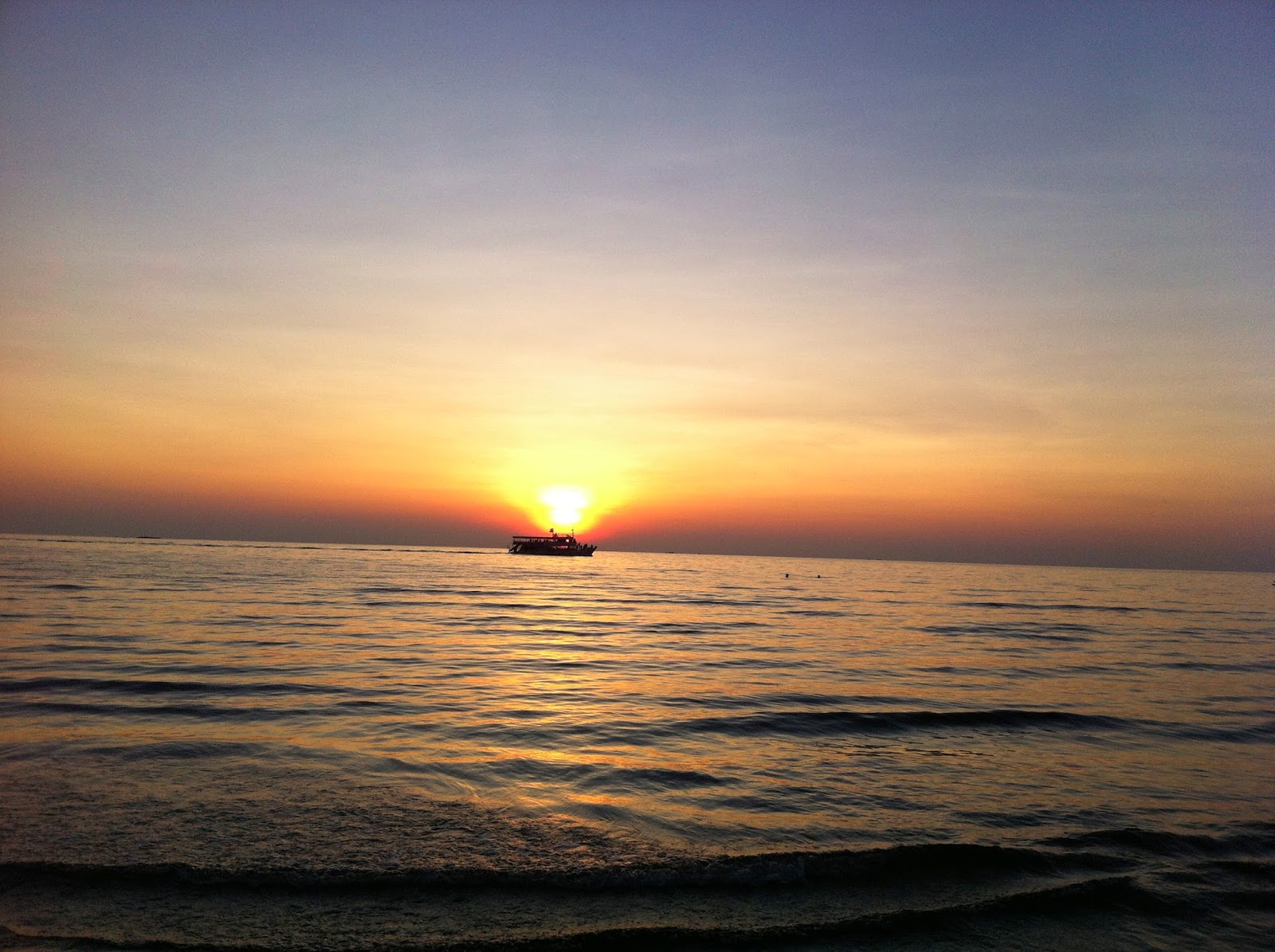
Along the west coast of Koh Chang, there are many places to place one self in a bamboo chair and take in sun sets. These are just a couple of the many pictures I have snapped on the beach near Khlong Phrao.

Thursday, April 3, 2014

Trad - Koh Chang Reminiscing

To me, Koh Chang, Koh Samui, Koh Phangan, and Koh Phi Phi were the original Bounty islands ... i.e., with beaches and scenery as if they could have been backdrops in commercials for Bounty chocolate bars. That sentence is on purpose in past tense because it was true 20 years ago, but these islands have developed dramatically over the past decades.

The beaches are still stunning and it is still possible - although difficult - to find quiet spots.
During my first visits to Koh Chang, the road from the ferry to Had Sai Kao (White Sand Beach) was only partially paved with concrete. The road stretched from Had Sai Kao to Had Khai Bae (Rooster Crow Beach) was gravel and without bridges at several of the river crossings. The road ended at Had Khai Bae.

The ferries were converted fishing vessels and only for people, not for vehicles. They stopped not only at Ao Sapparot (Pineapple Bay), but continued to Had Sai Kao and Had Khai Bae. So, after I realized that, I stayed on the ferry until last stop.

Back then, there was no entrance fee to visit the waterfall, there were no elephant rides, no condominium developments, and no "gibbon rides". Banana boats could only be found at Had Khai Bae.

Back then, Koh Chang was a heaven for backpackers and students like me on a tight budget. I could take a long weekend trip down (leave Bangkok Friday evening, return Monday evening) for less than 1,300 baht (roughly USD 50 back then) with all my expenses covered.

Today's youth and backpackers require air conditioning and comfort, so prices are obviously a lot higher now. The Robinson Crusoe experience is gone, but the sunsets are still great.


Saturday, October 5, 2013

Thailand - SCUBA


http://tinamue.blogspot.com/2012/10/thailand-off-deep-end.html

There is a normally unseen world beneath the ocean’s surface. There are many companies offering trips and certification in diving with Self-Contained Underwater Breathing Apparatus (SCUBA) equipment. If you have time and loves the sea, diving is definitely a hobby you should consider taking up.
Don't get too close or I'll bite
Underwater photography can relay the sights that can be had, but diving is an activity that involves all senses (except maybe smelling) and is an exciting and rewarding experience. 
Can you see me?
Moreover, speaking from personal experience, it is an activity that is much more relaxing and overall better in tropical waters than in colder climates.

Wednesday, March 13, 2013

Cambodia - Sihanoukville Revisited

A couple of years ago, when visiting Sihanoukville, I got the feeling it had become like a town in the wild west – money could buy you anything and opportunities abounded for investors flashing cash. Russian tourists and Russian money (of dubious origin) poured in. Big plans were hatched and entire islands were snapped up (e.g., www.morakotisland.com) by investors with deep pockets.
Now, the situation is quite different. Some of the Russian money men stepped on the wrong toes and their projects went nowhere. The bridge to Koh Phous (Morakot Island) was opened with great fanfare January 1, 2012, but then closed almost immediately thereafter.

Russian tourists no longer flock to the beaches around Sihanoukville, so several hotel projects have been put on hold. For a guy like me, that’s great because I don’t like crowds and the beaches near Sihanoukville are superb.
One side effect the “Russian boom” (although now bust) has had is that the Internet got filled with warnings that the Cambodian islands all were about to be turned into playgrounds for the ultra-rich. Among back-packers, this created a rush to visit these islands before they disappeared. To stay on one or more Cambodian islands became an almost mandatory activity for back-packers passing through Sihanoukville.

As a consequence, the few rustic resorts that were on the islands could not cope with the demand and they expanded capacity. Moreover, entrepreneurs rushed to sign lease agreements and build new resorts in order to meet the demand. Still today, occupancy rates on the islands remain high so more and more bungalows are being built on the islands.
In other words, the big bad Russian plans are no longer a threat to the Cambodian islands, but the demand created by back-packers is gradually resulting in that the Cambodian islands soon will be Paradise Lost just like Koh Samui and Koh Phangan and many other Thai islands are.

Anyway, if you are not a beach freak, there is also a quite nice waterfall to visit while in Sihanoukville. That is, if you can find the dusty road that will take you there. They could do a lot to improve road signage in Cambodia, but I get by with sign language to get directions.
However, some times this approach may result in mistakes and detours, which simply has to be taken as an added experience. In one instance it may take you to a rural village during rice harvest or it may take you through a slum where one gets a taste of what it really entails living on less than USD 2 per day. 

Saturday, February 2, 2013

Surat Thani - Koh Samui


Bangkok, Koh Samui, and Koh Phangan were my destinations the first time I visited Thailand. Back then- before the airport on Samui opened for commercial flights – things were very different from now. Back then, backpackers and sex addicts were just about the only tourists making it to Thailand and sex tourists didn't venture outside Bangkok.

I remember Bhoput as a tiny sleepy fishing village with a few restaurants – one also served as post office and as a place where one could cash in travelers’ cheques (credit cards were not something backpackers had) – that among other things served omelets with magic mushrooms. On the beaches outside Bhoput there were some small family-run resorts with basic bungalows and basic facilities - nothing like the 10,000 baht/night resort with an artificially enhanced beach (see picture above) that I last Songhkran was cornered into staying at. Having a private hot tub in your room is nice, but it doesn't make my day.

Anyway, back then Bhoput was primarily known as the place one could get on a long-tail boat and head to Koh Phangan. Back then, there was no such thing as full moon parties. Back then, there was no electricity on Had Rin. The bungalows were small huts mostly made of bamboo and banana leaves. At night, people gathered around bonfires, talked, played guitar, drank, and enjoyed being away from civilization. To reach the other parts of the island, one had to take a long-tail boat or walk around a cape to the next beach, but this was only possible at low tide. I decided for a challenge and decided to climb the steep ridge that isolated Had Rin from the rest of the island. That was not a wise move – but I was young and foolish and had plenty of time on my hands – as I ended up drenched in sweat while spending hours trying to navigate my way around dense humid jungle in 30+ degrees Celsius.

Now, Had Rin is full of air conditioned bungalows, tacky souvenir shops, bar beers, and 7-Eleven stores. Not even the illusion of “getting away from civilization” left.

Koh Samui has also gone upscale and become plasiticized (if such a word exists). During my first visit, I had to drive my rented motorcycle into the jungle (track too narrow for cars) and then trek to reach a waterfall. 

Now, what one has to navigate one's way past is not a dense jungle, but a multitude of elephants-for-rent and peddlers of time-share deals.


Between the main road and the beaches of Chawaeng and Lamai, there used to be a tiny dirt road lined with a few basic resorts. Now, these villages have developed into modern towns complete with Starbuck’s and McDonald’s so that it easy for the tourist to forget he / she is not on Ibiza or Miami Beach. Even Big Buddha has succumbed to commercialization.

Memories of back when things were more “original” are all I have left, and to keep them, I tend to avoid visiting Koh Samui.

Monday, January 7, 2013

Phang Nga - Koh Surin


When arriving (by boat of course) to the small archipelago Mu Koh Surin, the view is stunning. You feel like you have arrived at the setting for these advertisements seen for Bounty chocolate bars and other goodies peddling images of snow white powdery beach sand and palm trees billowing in a gentle breeze.
Mu Koh Surin is a national park located in the Andaman Sea, 80 minutes by speedboat from the coast. If you do not bring your own tent, basic accommodation (tent or large bungalow) can be provided by the national park on Koh Surin Nua. Due to the limited capacity, it is highly recommended to call in advance if you plan to go over a long weekend where many other often get the same idea. Since there is only one speedboat “ferry” per day, which departs from Kuraburi, you should secure your ticket in advance unless you have the cash to rent you own boat.

Once on the island, there isn't much to do apart from enjoying the sights. The small shop and restaurant close at 8 PM while lights are out by 9 PM. Koh Surin is not a party island like Koh Samed or Koh Phangan – people go to bed (sleeping bag) early and get up early.
There is a nature trail (2+ kilometers long) between the two camps on the island, but most visitors focus their activities on the sea. The bays have wonderfully clear water and coral reefs can be reached after swimming 25-30 minutes. A park ranger told me that corals on lower water depths were killed a couple of years ago when a warm ocean current persisted for too long. But there are still many fish even at the lower water depths.

If it is not up your alley to have to swim 30 minutes before you can start diving to watch corals, then day trips can be arranged where long-tail boats will take you to good snorkel locations. 

Wednesday, October 10, 2012

Satun - Koh Lipe

Koh Lipe is located in Satun province; roughly 65 km off the coast at the edge of Tarutao National Marine Park. It is near a group of around 50 uninhabited island with deserted beaches, waterfalls, and breathtaking viewpoints to visit.

Koh Lipe is home to some six hundred Chao Lei people who are descended from 'sea gypsies' that have lived on the Andaman coast for centuries. Masters of the sea, the Chao Lei settled on Koh Lipe when the King of Thailand offered them citizenship and land in return for settling the island, and thus at the time helping to fix Thailand's southern sea border with Malaysia. 

Not so reliant on the sea as they once were, the local community is adapting to the changes tourism are bringing.This development includes dive schools, an increasing number of resorts, and a tacky "walking street" (named after an infamous stretch in South Pattaya).
However, if you can ignore the unfortunate aspects of development, Koh Lipe is a great beach holiday destination albeit not in the rainy season. The island is surrounded by beautiful coral reefs and ocean marine life perfect for snorkeling and scuba diving. 

Friday, October 5, 2012

Thailand - Off the Deep End

In the Andaman Sea and in the Gulf of Thailand, there are plenty of dive sites and SCUBA diving is a popular activity among tourists. However, I was surprised when I heard that dive schools on Koh Tao combined annually issue so many PADI licenses that it makes Koh Tao rank third in the world. I have not been able to independently verify this claim.  
Almost all diving in Thailand is done from boats - big or small - and mostly on daytrips. Live-on-board dive trips is a great option if you have the time and money. Such trips can last from 3-4 days to two weeks and accommodation can be basic or luxurious.
Seeing coral reefs and colorful fish up close is interesting, but more exciting is wreck diving.

Monday, October 3, 2011

Krabi - Koh Lanta

Koh Lanta is a medium-sized island with some very nice and long beaches. As the Ao Nang area got more and more crowded, and as Koh Phi Phi got too commercial, Koh Lanta gained popularity. Back in 2004, real estate developers had started to market the island and plans were hatched to put tarmac on the last strip of dirt road. From 2006, when the tourist arrivals picked up again after having suffered a brief setback due to the tsunami, Koh Lanta had become an important "alternative destination" for tour companies, i.e., crowded, but not as crowded as Phuket, Phi Phi, Ao Nang or Khao Lak.


If you don't seek solitude but don't want too rampant commercialism or in-your-face sex tourism, then Koh Lanta is still a worthwhile holiday destination. However, I prefer to remember it as it once was.

My first visit to Koh Lanta was over 10 years ago -- just after Thai Airways had started domestic flights from Bangkok to Krabi. Back then, access to Krabi's hot spring was free of charge and the Tiger Temple (no live tigers there, but a big rock to climb from where to enjoy the view) was not too crowded. 


And back then, Koh Lanta was still considered a backpacker destination. As roads were considered rough (i.e., unpaved), I was advised not to go there in a sedan. So, a friend of a friend arranged that I borrowed a pick-up truck for the journey from town to island.


That was a great favor so I didn't ask too many questions or check the gifted horse. I was not until I had parked to wait for the ferry that I took a closer look at the truck. And I look twice. It had no license plates nor any registration sticker. 


I immediately called the owner to hear if I missed something. No problem, I was told.  "The Krabi police knows me (and my truck), so I'm never pulled over. If any police tries to make an issue, just call me." Uhm, OK. 


Now, I was already at the ferry so why not continue on to the island. What could possibly go wrong?


And I was wrong. Nothing happened. For three full days, nobody paid any attention to the missing license plates. Meanwhile, I had checked the "credentials" of the vehicle's owner. It turns out that he was the local ringleader for the underground lottery, which explained why he had an "arrangement" with the local police. 


Anyway, sorry for the digression.


I just want to say that Koh Lanta is nice and gets nicer the further south on the island you go, i.e., away from the crowds. 

Monday, August 22, 2011

Phang Nga - Koh Kho Khao

Between Takua Pa and Khao Lak is Ban Kem. This village is the location for a large tsunami memorial. To access the location, one has to turn off Highway Route 4 (it’s very easy to miss the sign but it's near the 774 kilometer marker when coming from Bangkok) and drive several kilometers on small roads before reaching the memorial. 
There are so few visitors to the memorial that the food and souvenir stands built nearby were not occupied by sellers until last year. Now a restaurant has opened on the nearby beach, which is good for swimming and offers great views of nearby Koh Kho Khao.
This island is 15 km long and can be reached by long-tail boat or car ferry from Ban Nam Kem. The island had just started dabbling into tourism when the tsunami hit. It took a few years before it had recovered, but the island is now the center of attention with real estate agents trying to sell beach villas. However, judging from the closed souvenir & tailor shops and the boarded up real estate agencies, sales and tourist arrivals are not booming the way it had been hoped for. 
New upscale resorts have sprung up vying for tourists to come up from Phuket and Khao Lak. Their websites are in English and Swedush, but not in Thai. Other upscale resorts focus on Bangkokians and have adjusted their marketing accordingly. 


The island has wonderful and deserted beaches - the above picture shows tracks from a small herd of cows that had taken a morning stroll on the beach. 


The below picture shows Koh Phrathong, which is located a stone's throw north of Koh Kho Khao.
Apart from beaches, Koh Kho Khao has a lot to offer. There is bird watching, kayaking, ancient ruins of the remnants of a trading post, and a public swamp - no kidding.


Koh Kho Khao is still relatively undeveloped and a great place to get away from the crowds. One can walk undisturbed on the beach for kilometers and can - at night obviously - enjoy clear views of moon and stars without any light emitted from cities or large resorts. 

Tuesday, March 29, 2011

Surat Thani - Koh Nang Yuan


One of the most astounding examples of a destination that has gone upscale is Koh Nang Yuan in Surat Thani Province. This small island (looks like three rocks connected by sand barriers that barely exist at high tide) is located a stone-throw from Koh Tao.
Koh Tao used to be a destination for backpackers, then for dive enthusiasts, but now the island has more and more spas and resorts that cater for families. However, in terms of going up-scale, the resort on the privately owned Koh Nang Yuan takes the price.
The marketing concept for Koh Nang Yuan used to be similar to Koh Kood – target weekend visitors from Bangkok – and rustic bungalows (with great views) would cost 800-1,500 baht per night. Today, the island is home to a “dive resort” with luxurious bungalows costing 2,500-7,5000 baht per night.
Despite these to me scary prices, I must admit that this small island is extremely beautiful and a must-see.
My recommendation is to avoid tour operators and do a bit of footwork yourself. Take the night train down to Chumphon and catch a song-taew taxi to the catamaran ferry to Koh Tao (www.lomprayah.com) or drive your own car to the ferry jetty where ample parking is available.

Wednesday, March 23, 2011

Trang - Koh Laoliang


View of Koh Lipe from Koh Laoliang

Koh Laoliang is one of many beautiful islands in Trang. It is also one of the smallest. It only has one "resort" where guests sleep in large tents. Geographically small, Koh Laoliang is definitely a niche destination and not for those who want hordes of people all around all the time.


Leaving Koh Laoliang

Koh Laoliang is part of a national park and the island's "resort" is managed by the national park service. The island has several good challenges for rock climbing enthusiasts and the use of kayaks is free of charge.

All in all, it a nice place to relax with a book and/or with a "significant other".

However, the food isn't great and sun-seekers will be disappointed to find out that the beach falls into the shade of the rocks by mid-afternoon thus robbing them of precious time under the tropical sun. So, if you are into sun until dinner time and a minimalist night life, the you should go to nearby Koh Lipe.

Sunday, March 20, 2011

Trat - Koh Mak


15 years ago, the infrastructure on Koh Chang was very basic. Back then, visitors were mostly intrepid backpackers daring to take exhilarating climb & descent from the pier to reach Had Sai Kao followed by a rough-and-rumble drive over narrow rickety bridges to reach Had Kai Bae. Alternatively, you could stay on the ferry (a slightly converted fishing vessel) and reach Had Kai Bae in a more leisurely manner.


Back then, there were no elephant safaris or 7-Eleven shops, nor any entrance fees to be paid to go swimming in the island's waterfall.

But since 2000, when the road along the western coast line was extended and upgraded, development has gone incredibly fast. Backpackers (now an almost extinct species) have been replaced by mass tourism – a mixture of foreign families on package tours, sex tourists, and affluent Bangkokians.

Trying to escape this commercial onslaught, I sought refuge on Koh Mak and Koh Kham a few years back. For a period, these were nice and relaxing places to walk barefooted on relatively secluded beaches. But sadly, cohorts of luxury demanding tourists soon found their way to Koh Mak resulting in upgrades, price increases, and real estate “development”.

However bad, it is still less intrusive and blatant compared to what has been going on in Cambodia and on Koh Chang over the past 5-6 years. Koh Mak is still worth a visit for those wanting to escape the crowds on Koh Chang.

Tuesday, March 15, 2011

Rayong - Koh Samed

This island was a great backpacker destination 15 years ago. That was when people didn’t have phone, satellite TV, or internet. Back then, most resorts on the island was connected with the mainland with NMT 470 mobile phones that weren’t mobile unless they were in the trunk of a car. At resorts’ restaurants, they’d show two video movies (video tapes, not DVDs) to keep guests entertained.

Since then, development has moved ahead – faster and faster – and the backpackers have all but gone. In Ao Maprao, a couple of small family-run resorts were razed to make space for a condo building. Jet skis were allowed to race first along White Sand Beach, and then along the whole east coast. And today, all resorts have WiFi as today’s wealthy tourists have to stay in contact with the rest of the world.

I don’t like the crowds, so I haven’t visited Koh Samed much the last few years, but the island still has some impressive bays along the southern part of its east coast.

Thursday, March 10, 2011

Trat - Koh Kood

Local mermaid
Koh Kood is one of the few Thai islands of a reasonable size that is still relatively untouched by mass tourism. 

The island’s resorts – probably due to the long time it takes to reach the island from Bangkok – continue to focus on offering 3-4 day packages, i.e., they basically cater to Bangkokians wanting a (long) weekend getaway rather than to mass market foreign tourists staying for one or two weeks. 


Peter Pan, Tinkerbell, and Captain Hook – three resorts with the same owner – are examples of how Koh Kood has gone upscale. I must admit the resorts have been done in great style/design, but I still miss how it was 10 years ago.There are also few budget resorts that attract the few remaining backpackers who still travel the globe.


The island doesn't have “facilities” to serve the cravings of sex tourists, so it is a great family destination. The island’s bays have clear water, the food is good, and unlike a few years back, the GSM and internet connections are excellent.