Sunday, May 25, 2014

Chantaburi - a multitude of options

Chantaburi has something for everyone. The province has great beaches, highlands with waterfalls and hot springs, remnants of gem mines as well several destinations for history buffs. In a temple in the city center, Buddha statues are kept in a building with a roof shaped like the helmet worn by the great Taksin who won Siam back from the Burmese.
Chantaburi was from where the general (later king) gathered his forces, built his fleet, and subsequently launched his attack on the Burmese. Later, Siam came under pressure from the expansionist French that didn't think French Indochina was quite large enough. French troops therefore marched up the coast from today's China and didn't stop until they reached Chantaburi. 
French-built "Chicken-shit Prison"
They occupied the territory until the king of Siam gave two of "his" Cambodian provinces to the French. The French combined incarceration of Thai prisoners with farming - there is a structure near Laem Singh, which used to have prisoners on the ground floor while the top floor was a chicken coop. Due to gravity, the prisoner were "showered" in chicken droppings, which they obviously saw as a great insult.

Beach destinations include Laem Singh and Hat Chao Lao (with Laem Sadet)

http://tinamue.blogspot.com/2011/12/chantaburi-laem-singh.html


http://tinamue.blogspot.com/2010/02/chantanaburi-chao-lao.html

The road from Chantaburi city to Sa Kaeo city goes parallel to the Thai border with Cambodia and there are a couple of small "border markets" and lots of waterfalls along the way. The key destination in that area is Soi Dao.
Rolling hills near Soi Dao

Thursday, May 15, 2014

Suphanburi - Buffalo Show

I passed through Supanburi and decided to drop by the Buffalo Village.


Unlike my first visit, this time there was no special (high) entrance fee to pay although the sign still says Caucasians have to pay five times the rate Asians pay. 
Isuzu of olden days
The show and the sights (feed a buffalo, ride on a buffalo etc) were the same. Well worth a Thai entrance fee, but not worth a farang entrance fee.
Brother, can you spare a dime for another slurpee?

Saturday, May 3, 2014

Khon Kaen - More Dinosaurs

On my way to Loei. I saw a road sign and decided to take a detour to a dinosaur museum. It turned out to be located in the middle of nowhere in Khon Kaen - or rather on the road to Phu Wiang National Park. A geological formation – a crescent shaped ridge – leaves only one road in and out to the museum.
A Friendly Dinosaur
The outdoor area covers 160,000 square meters, but the museum itself was not as impressive as the one in Nong Bua Lamphu (http://tinamue.blogspot.com/2013/02/nong-bua-lamphu-dinosaurs.html) and did – as unfortunately is usual in Thailand – charge Caucasians more than Thais. 
A Less Friendly Dinosaur
Since there actually isn’t much to say about dinosaurs in Thailand, the museum also went at some length to explain the evolution of species and geological formations.

Wednesday, April 23, 2014

Surat Thani - Koh Samui Reminiscing

Koh Samui is today a modern resort island with direct international flights making it easy for tourists to get to the island.

It is not particularly Thai anymore as it competes to find its spot in the market place where other "beach & party islands" like Phuket and Bali vie to attract the same crowd. While Samui tries to move upscale, it still also attracts tourist hordes from Russia and the modern version of backpackers on their way to / from the monthly Full Moon Party on Koh Phangan.

When I first visited Koh Samui, there were no scheduled flights - the airport was tiny (could only be used by single-engine prop planes) and rarely used, there were no Full Moon Parties, and locals seemed mostly engaged in growing coconuts. Many people lived in wooden houses on stilts with their livestock - water buffalo included - roaming around freely.

The beach roads in Chaweng and Rawai were rough gravels roads. Bo Put was a sleepy fishing village where the local shop (too small to be a supermarket) doubled up as restaurant, post office, and exchange booth. There were no resorts with infinity pools and beach chairs, but the beaches were absolutely stunning and totally deserted.
I also remember that my visit to the waterfall was an adventure. Only the main road circling around the island was paved (concrete). All other roads were gravel roads. The road to the waterfall quickly became a track only to be used by motorcycles. A few kilometers from the waterfall, the track became impassible except on foot as it wound its way through the pristine jungle. After a semi-arduous journey, it was with great pleasure one stripped off one's wet T-shirt and jumped into the cold water at the foot of the waterfall.
Today, Samui's beaches aren't deserted and access to sights such as waterfall are neither arduous nor for free.

Friday, April 11, 2014

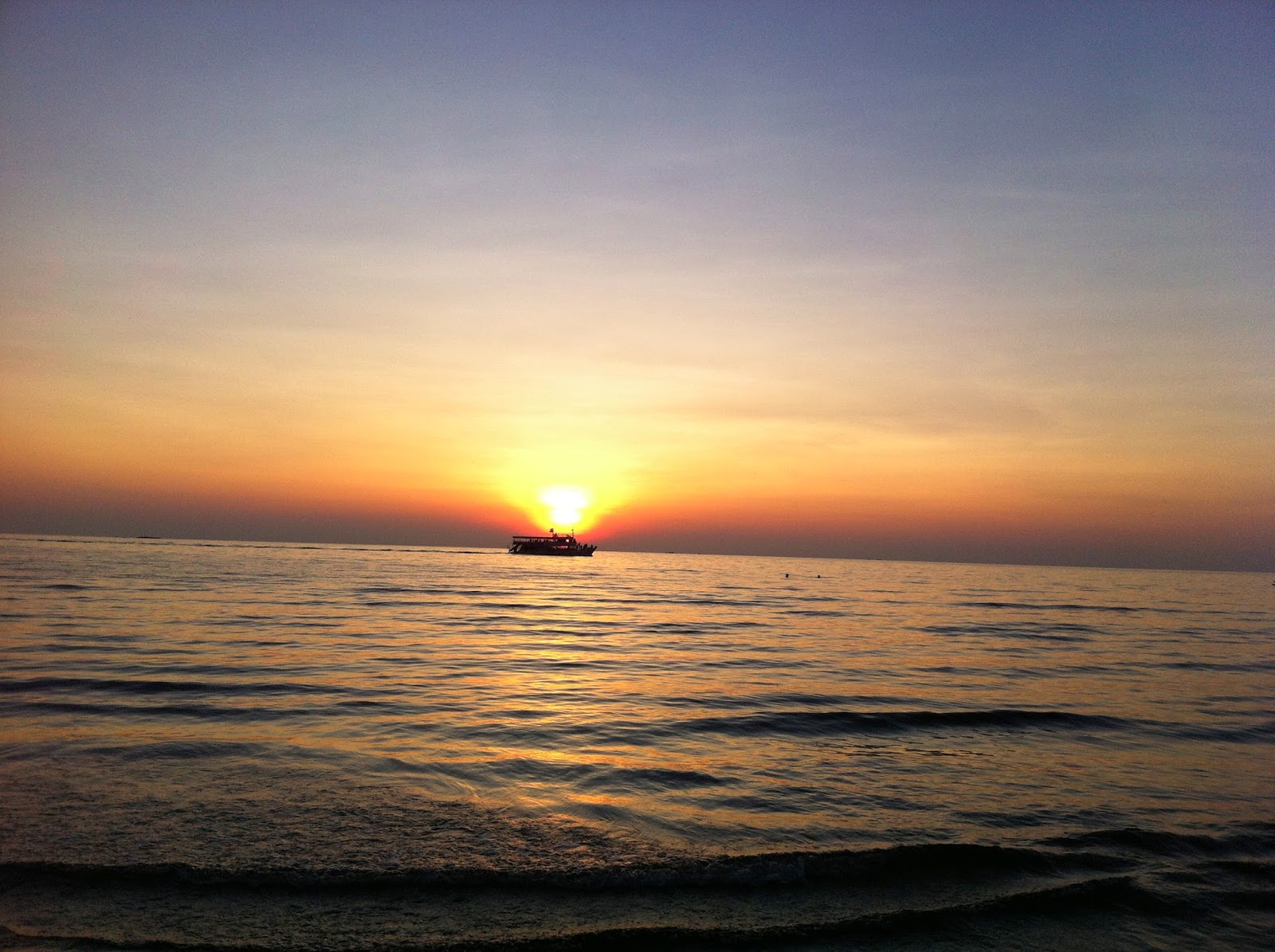
Trad - Koh Chang Sunsets

As we are getting ready for a busy week - the annual road carnage and excessive water splashing -to celebrate Thai new year, let's pause to appreciate the nature that surrounds us.
Along the west coast of Koh Chang, there are many places to place one self in a bamboo chair and take in sun sets. These are just a couple of the many pictures I have snapped on the beach near Khlong Phrao.

Thursday, April 3, 2014

Trad - Koh Chang Reminiscing

To me, Koh Chang, Koh Samui, Koh Phangan, and Koh Phi Phi were the original Bounty islands ... i.e., with beaches and scenery as if they could have been backdrops in commercials for Bounty chocolate bars. That sentence is on purpose in past tense because it was true 20 years ago, but these islands have developed dramatically over the past decades.

The beaches are still stunning and it is still possible - although difficult - to find quiet spots.
During my first visits to Koh Chang, the road from the ferry to Had Sai Kao (White Sand Beach) was only partially paved with concrete. The road stretched from Had Sai Kao to Had Khai Bae (Rooster Crow Beach) was gravel and without bridges at several of the river crossings. The road ended at Had Khai Bae.

The ferries were converted fishing vessels and only for people, not for vehicles. They stopped not only at Ao Sapparot (Pineapple Bay), but continued to Had Sai Kao and Had Khai Bae. So, after I realized that, I stayed on the ferry until last stop.

Back then, there was no entrance fee to visit the waterfall, there were no elephant rides, no condominium developments, and no "gibbon rides". Banana boats could only be found at Had Khai Bae.

Back then, Koh Chang was a heaven for backpackers and students like me on a tight budget. I could take a long weekend trip down (leave Bangkok Friday evening, return Monday evening) for less than 1,300 baht (roughly USD 50 back then) with all my expenses covered.

Today's youth and backpackers require air conditioning and comfort, so prices are obviously a lot higher now. The Robinson Crusoe experience is gone, but the sunsets are still great.


Sunday, March 16, 2014

Chantaburi - Khao Khitchakut 2

Access to the Khao Khitchakut is possible for two months each year, normally between Chinese New Year and Magha Puja day (roughly late January to March).

I reported on Khao Khitchakut two years ago.

http://tinamue.blogspot.com/2011/12/chantaburi-khao-khitchakut.html

Drop point at top of dirt road. The trek begins from here.
The pilgrimage to Khao Khitchakut gets ever larger. While it was bad two years ago, it is now a total "circus". Fortunately, getting the two rides on pick-up truck to the top went quite smoothly. Many passengers seemed awestruck that it is possible to drive relatively fast on a dirt road - not something they are used to when shuttling around Bangkok in their air conditioned sedans - so they were recording the rides on their mobile devices. The road to the top is a dirt road, but it is relatively wide and relatively smooth. Although steep at places, it was a much better road than some of the tracks I've been on in Ratchaburi and Kanchanaburi.  And it is simple physics that it makes it easier to drive up if speed (and thus forward momentum) is kept above 20 km/h.
You shall not walk alone
After driving 3-4 km from bottom to top, it is time to get off the pick-up and dive into the sea of people. The path leading up is mostly narrow and always cram-packed. Patience is required. After less than a kilometer, the track really narrows and gets steep. Obviously, this creates a bottleneck. After waiting for twenty minutes without moving more than a few inches, an experienced pilgrim (this being her fourth visit) remembered a short-cut. I and a few others followed her. We back-tracked 100 meters, veered off the paved but crowded track, sneaked in between some ramshackle shops, passed some temporary toilets, and there it was: a path in the forest leading up. It was a steep climb, but there wasn't any crowd.

Once up at around 1,000 meters above sea level, and back into the crowd, one has to walk from peak to peak to pray and to admire the various geological phenomena that to pilgrims appear to be related to Buddhist myths. For example, there is a stone pagoda, a rock that looks as an upside down monk’s alms-bowl, the hermit cave, and huge rocks that look like a turtle and an elephant.
Patience - it took around 40 minutes of standing in line before the rock was reached
The most famous / important destination is Lord Buddha’s footprint (at the foot of the rock pictured above). There the ushers (broadcasting via large loudspeakers) remind people that a 200 baht donation could (potentially) result in lottery winnings of 200 million baht. Not a bad rate of return. One also suggested other wishes one could make such as getting "Pancake" as one's girlfriend.

For a clue to who Pancake is, check out:

http://tinamue.blogspot.com/2011/08/thai-nicknames.html

At other holy locations, the guys with microphones promised less - the promises ranged from 3 - 5 million baht - and nobody saw any irony in that Buddhists come to pray for material success in life when Lord Buddha teachings center on that craving leads to suffering.
Write your wish on a red cloth, tie the ribbon, and pray.
Another interesting praying location had several options for people, including statuettes of Lord Buddha and of King Taksin the Great. Again without the slightest whiff of irony, there were also several statues of Hindu gods that people could pray to.
Buddhists can pray to Hindu gods
If you like crowds and/or if you believe Buddha will make your wishes come true, a visit to Khao Khitchakut is a must.